
Advanced Robotic Solutions at The Happy Gut Clinic, Greater Kailash-1
A diagnosis of rectal cancer requires a surgical approach that is fundamentally different from other intestinal cancers. Because the rectum is located deep within the narrow, bony confines of the pelvis, surgery in this area is a matter of “millimeters.” The goal is twofold: complete removal of the cancer and preservation of the delicate nerves and muscles that control bowel, bladder, and sexual function.
At The Happy Gut Clinic, our specialists Dr. Subhashis Das (GI Oncosurgeon) and Dr. Jayadatt Pawar (Robotic Specialist) are experts in Total Mesorectal Excision (TME)—the gold standard for rectal cancer. Using the latest robotic technology in South Delhi, we prioritize “Sphincter-Saving” surgery to help patients avoid a permanent stoma whenever possible.
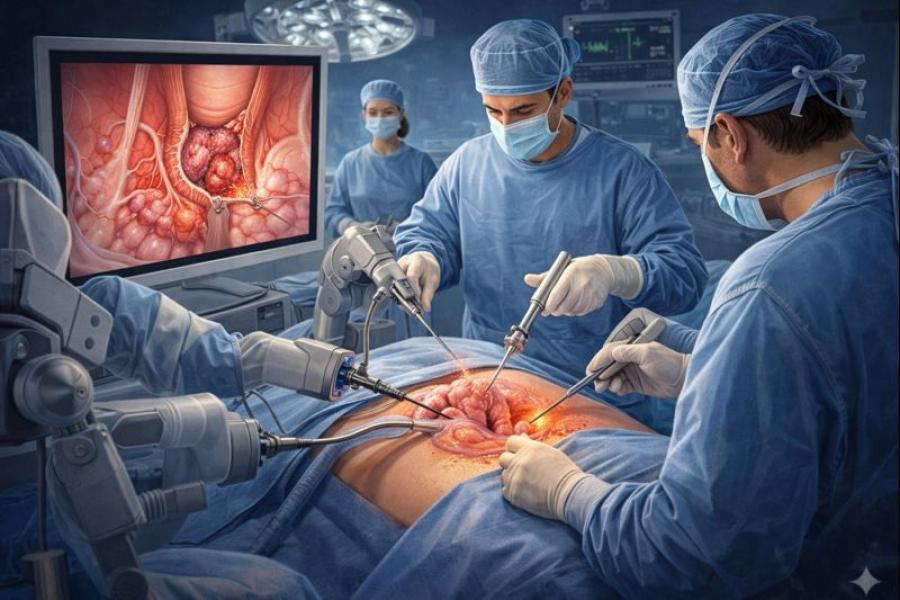
The Gold Standard: Total Mesorectal Excision (TME)
The most critical factor in preventing rectal cancer from returning is the surgical technique used.
- The “Envelope” Concept: Rectal cancer tends to spread within a fatty envelope called the mesorectum.
- Precision Clearing: During a TME, our surgeons meticulously remove the entire rectum along with this intact fatty envelope.
- The Outcome: This “clean” removal significantly lowers the rate of local recurrence and is considered the most important step in a curative treatment plan.
Our Specialized Surgical Procedures:
The type of surgery is determined by how close the tumor is to the anal sphincter (the muscle that controls bowel movements).
- Low Anterior Resection (LAR): For cancers in the upper or middle rectum, the diseased portion is removed, and the remaining colon is reconnected to the lower rectum. This preserves the natural passage of stool.
- Ultra-Low Anterior Resection: For cancers very close to the sphincter muscles, we perform a deep pelvic dissection to remove the cancer while keeping the anal opening intact. We often create a “J-Pouch” (a reservoir made from the colon) to mimic the storage function of the removed rectum.
- Abdominoperineal Resection (APR): In cases where the cancer has physically invaded the sphincter muscles, the anus must be removed to ensure all cancer cells are cleared. In these instances, a permanent colostomy is created. Our team provides extensive counseling and support for patients undergoing this life-saving procedure.
The Robotic Advantage: Navigating the Pelvis
The pelvis is a cramped space filled with vital nerves and blood vessels. Dr. Jayadatt Pawar utilizes robotic systems (daVinci / Hugo RAS) to overcome the limitations of traditional surgery.
- Nerve-Sparing Precision: The 3D high-definition camera allows the surgeon to identify and protect the “Autonomic Nerves.” Protecting these nerves is essential for maintaining post-operative urinary control and sexual potency.
- Superior Dexterity: Robotic instruments have a greater range of motion than the human wrist. This allows our surgeons to operate deep in the pelvis with ease, ensuring a more thorough “clearance” of the cancer.
- Stable Visualization: Unlike laparoscopy, where the camera may shake, the robotic camera is perfectly stable, allowing for a meticulous TME.
Why The Happy Gut Clinic?
- Sphincter Preservation Specialists: We exhaust every technological and surgical option to perform “Sphincter-Saving” surgery, helping our patients maintain their natural bowel function.
- Dual-Expert Synergy: Dr. Subhashis Das brings an oncological perspective (ensuring the cancer is gone), while Dr. Jayadatt Pawar brings robotic mastery (ensuring the function is saved).
- Multidisciplinary Coordination: We coordinate with oncologists for “Neoadjuvant Therapy” (radiation/chemo before surgery), which can shrink the tumor and increase the chances of saving the sphincter.
- Comprehensive Stoma Care: If a temporary stoma is needed to allow the new connection to heal, our dedicated team provides expert education on stoma management and reversal.
Recovery and Quality of Life:
Recovery from rectal surgery is a staged process. We focus on:
- The “Happy Gut” Re-training: After surgery, bowel habits may be frequent. We provide a customized diet and pelvic floor guidance to help your “new” rectum adapt.
- Early Mobilization: Our robotic approach ensures less pain, allowing you to walk within 24 hours.
- Long-Term Surveillance: We monitor you closely with scans, blood tests (CEA), and endoscopic checks to ensure you remain in the clear.
Frequently Asked Questions (FAQ's):
Thanks to robotic technology and ultra-low resections, most of our patients avoid a permanent bag. A temporary bag is often used for 8–12 weeks just to let the internal connection heal safely.
By using robotic “keyhole” incisions, post-operative pain is significantly lower than traditional open surgery, and most patients require minimal pain medication after the first 48 hours.
This depends on the tumor’s distance from the anus and its response to pre-operative radiation. A consultation and MRI at our clinic will give you a clear answer.
Contact Details
Ground floor, R 17, Hansraj Gupta Rd, near Vistech Eye Center, Greater Kailash-1, Block R, Greater Kailash I, Greater Kailash, New Delhi, Delhi, 110048
8438283406 / 8383010836
info@happygutclinic.co
Mon-Sat: 5:00 pm – 8:30 pm
Map Location
Your health is important to us.
Share your enquiry using the form below, and we’ll respond at the earliest.